
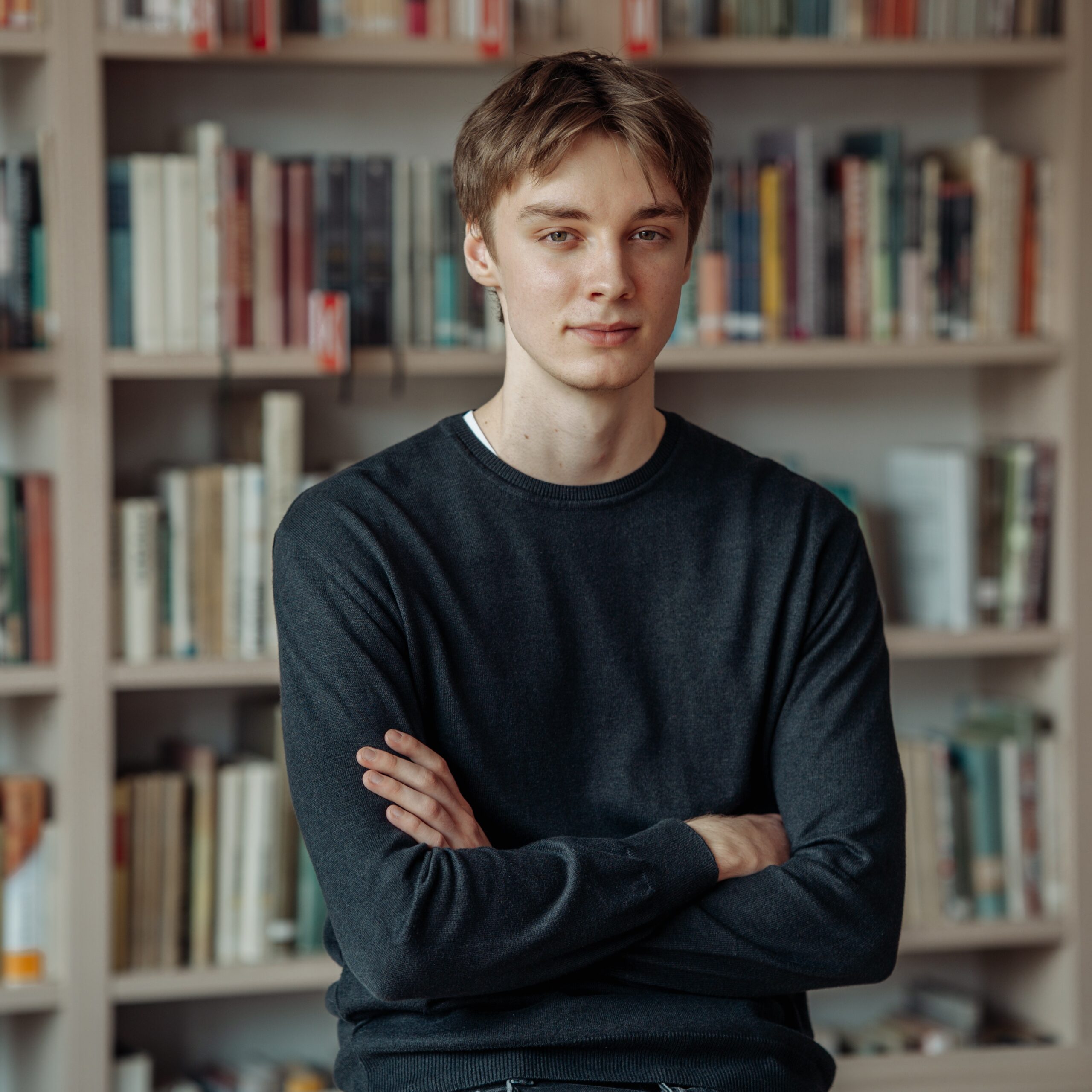
Where and how to obtain a scholarship? A lecture on this topic brought students from Rokycany Grammar School and Vocational School to the local library one Monday afternoon in April. They were probably all the more interested because it was given by their peers Šimon Vlach and Anna Drhovská, who are currently studying at the prestigious University College London. Šimon is also a graduate of the Rokycany Grammar School, and his journey to studying molecular biology was aided in part by the GoHigher programme. More than enough reasons to interview Šimon!
Šimon, you have been a student at University College London (UCL) since the autumn. You are preparing for exams to become a molecular biologist one day. You have probably been asked many times what a molecular biologist actually does, so I won’t catch you off guard, you probably have a rehearsed answer ready.
I often like to say that biology as such studies the most complex systems we know in this universe, and those are living beings. And I actually like that molecular biology tries to describe these living beings at the level of the molecules themselves, which interact with each other. It tries to see the basic structure of cells and describe more complex things, such as diseases.
In your presentation, you both mentioned the essays you had to write when applying for scholarships at UCL. One of the assignments was a question about whether you think your field can change the world in the future. I am eager to hear your answer.
I think biology as such has enormous potential; it’s not just about molecular biology, which intersects with other fields such as cell biology, pharmacology, and others. For example, I’m interested in the biology of aging. The idea that one day it might be possible to avert or completely eliminate diseases associated with aging is wonderful. In old age, the negative effects of wear and tear on the body accumulate, gradually disrupting the body’s balance, and we could get rid of these effects and extend our health span, which is the length of our life when we are healthy, or even our lifespan, which is the age we live to. It is one of the topics I find fascinating, and one that has not yet been thoroughly researched, with no groundbreaking findings to date and plenty left to discover.
For example?
This could be studying Alzheimer’s or Parkinson’s disease, osteoporosis, or aging in terms of cell wear and tear and genetic information. Advanced age is also associated with a higher risk of cancer, which is another disease a unified protocol for treatment would be great to have. In addition to these disease-related issues, molecular biology can also provide a wealth of other information which can change the world. It may be possible to create genetically modified bacteria that will break down plastic. Discoveries in molecular biology are, of course, linked to biotechnology, which can have a major impact in areas such as climate change, pollution, and biodiversity loss.
So we will need a lot of biologists; in fact, we already need them. But let’s now look at your path to this field of study. In your presentation, you said that it all had started with your love of animals. And then I saw two strong impulses. The first was your participation in Olympiads in science and chemistry, I assume.
In lower secondary school, I took part in just about every competition there was: biology, chemistry, mathematics, physics, but biology was always my favourite. I also went to various biology camps. At secondary school, I qualified for the higher A category of the Biology Olympiad, made it to the national round, and there I met people I hadn’t known before, who sparked my interest in molecular biology. I went to the Běstvina camp, which I recommend to everyone, as it has plenty of expert lectures on various topics. That same year, I also qualified for the first time for the European Olympiad of Experimental Science, an international event held in Hradec Králové that year. Our team, consisting of one chemist, one physicist, and one biologist, which was me, ranked in the so-called silver band. This motivated me to try the International Biology Olympiad, for which I qualified through the national round and after an intensive training camp at the Faculty of Science in Prague. The Olympiad was held in the United Arab Emirates, with almost 300 participants from around the world, four of us from the Czech Republic. I came in the silver band again, which was the top 30% of participants.
The other key point was probably the internship at the Biomedical Center in Pilsen in your final year of secondary school, right? There, you actually became a member of a research team.
It wasn’t exactly molecular biology, but rather tissue engineering, because the research group I worked with was involved in the subject of recellularization. It is a notion that you can take an organ, for example from a pig, in our case the liver, dissolve the cells in it, and try to replace them with human cells to create a functional organ suitable for transplantation, for example. My project focused on whether recellularization can be aided by exposure to ultrasound, which is known to increase the migration and adhesion abilities of cells.
And can it?
We didn’t find out much, but that’s often the nature of science. One often gropes in the dark for a long time, fine-tuning the methodology step by step, and a breakthrough sometimes comes only after a series of dead ends.
During this internship, you applied for a scholarship to study abroad. In addition to the UK, you also considered the US. What drew you into the world? Can’t you study molecular biology here?
Of course you can, but I think experience abroad is very important. There are scientific groups that are at the forefront of global research, and it would be amazing to be part of such a community. You also gain different experience abroad, and if it is common for us to go abroad as part of doctoral programmes, for example, why not for the bachelor’s and gain experience a little earlier?
But you are not just a graduate of the Rokycany Grammar School, you were also involved in the GoHigher programme, which builds a community of gifted young people in the Pilsen Region. Did that have an influence on you?
Of course, participating in camps helped me a lot, but those were under the auspices of the Pilsen Region; GoHigher didn’t exist at the time. In my senior year, thanks to GoHigher, I attended the Consider Science! conference, where I gave a lecture on the International Olympiad, and it was definitely a great experience in public speaking and lecturing on a topic. The event was great, and it was also designed to motivate students not to be afraid of science.
Do you think communities of people with similar interests and mindsets are important? Do young people actually need help here, or would they find a community on their own, only it might take them longer?
In many cases, you find a community on your own, but it’s much harder than when there’s a programme to help you. Such programmes are extremely important because people with similar interests can inspire each other, develop joint projects, and even realize what they enjoy the most. That’s what happened to me at the Molecular Biology Olympiad.
In the case of UCL, the community is probably the entire school, but you mentioned that there are also various student societies…
They operate within the student union, which is really large at UCL, and include societies such as the Genetics Society and the Biotechnology Society.
But you are also in more “ordinary” clubs, like singing, dancing, and theatre.
Yes, it is about students developing not only academically, but also in other areas they enjoy.
Finally, let’s look to the future and imagine an ideal situation where your studies and everything else go smoothly. What awaits you in the coming years? I am currently finishing my first year of the four-year Integrated Masters programme in Biological Sciences. After that, I should obtain a Master of Science degree and probably continue on to a PhD programme, either at another university in the UK or maybe in the US.
Do you want to return to the Czech Republic and work here, or settle elsewhere in the world? The Bakala Foundation, which supported you, no longer requires you to return to the Czech Republic, whereas e.g. the Kellner Family Foundation does.
It’s not an explicit precondition, but of course they are happy if people return to the Czech Republic and work here. But as the director of the organization told us, one can represent the Czech Republic just as well in Prague as in, say, Boston. So, there is the possibility of working in laboratories abroad, but I would not object to returning home if an opportunity arose to work for a biotechnology start-up or something similar, where I could work on the problems that the world is currently facing.
Šimon Vlach was born on 10th June 2005. He attended primary School in Blovice and grammar school in Blovice (lower secondary school), and Rokycany (upper secondary school). He is currently studying Biological Sciences at University College London in the UK. He is keen on playing the piano, fencing, hiking, and scuba diving.