
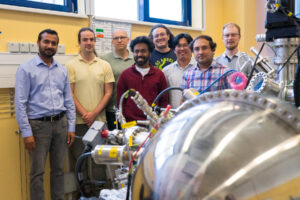
Sarath Sasi, M.Sc., a graduate of the Amrita School of Physical Sciences, in south India, continues his studies and career at the University of West Bohemia in Pilsen. He is studying for a doctorate and working at the University of West Bohemia’s New Technologies Research Center (NTC) in Professor Ján Minár’s team for Advanced and Quantum Materials Research, which combines theoretical modeling and experimental study of materials.
Sarath, you are a Ph.D. student and a researcher University of West Bohemia’s New Technologies Research Center (NTC). What brought you to science? Do you always wanted to do science?
My journey into science was not something I planned from childhood, but something that developed naturally over time. That brings be to study Physics and Mathematics at Amrita School of Physical Sciences, where I became increasingly curious about how the world works at a fundamental level—especially how tiny particles and atoms can determine the properties of materials we use every day.
What really drew me in was the idea that science is not just about learning facts, but about discovering something new. That curiosity eventually led me to research, where I could explore unanswered questions and contribute, even in a small way, to advancing knowledge.
You are involved in research into 2D materials, specifically 2D transition metal dichalcogenide alloys. What does that mean for a layman?
In simple terms, 2D materials are extremely thin materials—just a few atoms thick. You can think of them like very thin sheets that can be peeled from a larger crystal, similar to removing layers from a stack of paper. Because they are so thin, they often behave very differently from ordinary materials.
A special type of 2D materials I work on is called transition metal dichalcogenides (TMDCs). These materials are made of three layers of atoms: one layer of a metal (like molybdenum or tungsten) sandwiched between two layers of another element (like sulfur or selenium).
Now, when we talk about alloys, it simply means mixing different elements together within the same material. For example, instead of having only one type of metal or one type of surrounding element, we can combine them. This allows us to adjust or “tune” the material’s properties.
Your doctoral thesis is titled Evolution of Band structure in disordered 2D Transition Metal Dichalcogenide Alloys. Could you explain what is your research about and what is the goal of your doctoral thesis?
In simple terms, my research is about understanding how electrons behave inside very thin materials when we start mixing different elements together. Every material has something called a band structure, which basically tells us how electrons move through it. This is important because it determines whether a material behaves like a metal, a semiconductor, or an insulator. In my work, I study what happens when these materials are not perfectly ordered—when different atoms are randomly mixed. This is called disorder. While this may sound like a problem, it actually gives us a powerful way to change and control material properties.
The main goal of my research is to understand how this disorder affects the electronic properties of these 2D materials, and how we can use it to fine-tune their behavior. This knowledge helps in designing materials that are better suited for technologies such as energy-efficient electronic devices, memory devices, light-based technologies (like LEDs) and nanoscale sensors. In short, I am trying to understand how to control materials at the atomic level so they can perform specific functions more efficiently.
In addition to your studies, you are also a researcher at the NTC. What brought you to this research center five years ago? How did you find out about it?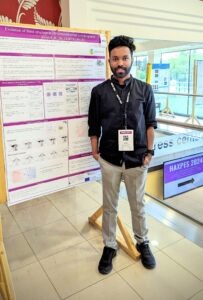
I was looking for a research environment that combines strong theoretical modeling with experimental collaboration. The New Technologies Research Centre (NTC) at the University of West Bohemia offered exactly that interdisciplinary platform. I came across the opportunity through academic channels and was particularly drawn by the research focus on advanced and quantum materials.
You work in Professor Ján Minár’s Advanced and Quantum Materials Research team. I heard from another foreign researcher that it was Professor Minár’s scientific work and his excellent reputation that brought him to Pilsen. Did you know him professor Minár before you started working in his team?
I was aware of Professor Ján Minár’s work through scientific literature before joining. His contributions to electronic structure theory and spectroscopy were well recognized in the field. This reputation played a significant role in my decision to join his research group. Also he is very supportive.
The team is international. What is it like to work in such a team? What are the advantages and disadvantages?
Working in an international team is a very positive and enriching experience. People come from different cultural and academic backgrounds, which brings a variety of perspectives to research discussions. This often leads to more creative ideas and better problem-solving.
It also helps me grow personally, especially in terms of communication and adaptability, as you learn to work with different styles and viewpoints.
There can sometimes be small challenges, such as differences in communication or working habits, but these are usually minor and can be easily managed. Overall, the advantages clearly outweigh the disadvantages.
Last year, you returned to your alma mater, the Amrita School of Physical Sciences, where you were invited to speak at a conference at the Amritapuri Campus. Could you tell us more about this experience?
It was a very special and meaningful experience for me. Returning to my alma mater, where my academic journey began, felt like coming full circle. I had the opportunity to present my research and also give a lecture to students in the same hall where I once sat as a student. That moment was quite memorable. My professors were very supportive and proud, which made the experience even more rewarding.
I also had many interactions with students who were curious about PhD life, how to apply for positions abroad, and what it is like to work in an international research environment. It was really nice to share my experiences and guide them based on my own journey.
 I assume that life in India and the Czech Republic is very different in many ways. What are the biggest differences? What surprised you the most in Pilsen?
Yes, there are quite a few differences, both in daily life and culture. One of the biggest differences I noticed is the work-life balance. In the Czech Republic, people place a strong emphasis on balancing work with personal time, which creates a more relaxed and structured lifestyle. Food is another noticeable difference. Czech food is generally less spicy compared to Indian cuisine, so that took some time to get used to. Language was also initially a challenge, especially outside the academic environment.
One thing that surprised me was the social culture around beer. In the Czech Republic, drinking beer is a very common and open social activity, even in public places, which is quite different from India.
You have been living in Pilsen for several years. What are your plans for the future? Can you imagine settling down in Pilsen forever?
At this stage, I don’t have a fixed plan to settle permanently in one place. In an academic career, it is important to gain experience from different institutions and countries, as it helps broaden both research skills and collaborations. That said, the New Technologies Research Centre (NTC) provides excellent opportunities for mobility, internships, and research visits across different parts of the world, which is very valuable.
I will be defending my thesis soon, and I would definitely like to continue at NTC, mainly because of the strong research facilities and the supportive team. In the long term, I may spend some time working in other places and possibly return later.
What do you like to do in your free time? What do you enjoy besides science?
In my free time, I like to relax and explore things outside of research. I enjoy trying different kinds of food and experiencing new cuisines, which is something I’ve especially appreciated while living in Europe. I also like going on small hikes and travelling to new places whenever possible. Exploring different cities and natural surroundings is a great way for me to unwind and recharge. I’m also interested in learning psychology, as I find it fascinating to understand how people think and behave from different perspectives. Apart from that, I enjoy spending time with friends and having casual conversations, which helps maintain a good balance with my research work.
What is your favorite place in Pilsen?
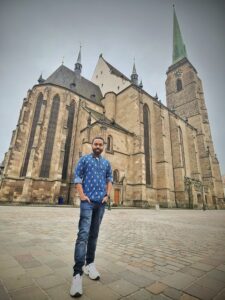
My favorite place in Pilsen is the city centre, especially around the cathedral. I sometimes go there, sit outside, listen to music, or read— If there is no programs happening. I also really like the Bolevec lake and the small forest areas around Starý Plzenec. These places are great for relaxing, going for a walk, and taking a break from work.
The New Technologies Research Centre (NTC), independent university institute of the University of West Bohemia, is focused on creating solutions for energy and technological transformation, climate adaptation, and improving quality of life. The institute specializes in green technologies, advanced and quantum materials that finds applications in energy, industry, healthcare, and the digital world. Since 2000, it has been combining basic and applied research with a strong emphasis on interdisciplinary collaboration.
There are two research teams at the NTC – the Infrared Technologies team, led by Prof. Ing. Milan Honner, Ph.D., and the Advanced and Quantum Materials Research team led by Prof. Dr. Ján Minár. Sarath Sasi, M.Sc., a graduate of the Amrita School of Physical Sciences in southern India, works in Jan Minár´s strong international team, which combines theoretical modeling and experimental study of materials.
Sarath Sasi completed multiple internships at CY Cergy Paris University and ATTOLab–CEA Paris, an advanced experimental laser facility dedicated to interdisciplinary studies of ultrafast dynamics, including electronic and nuclear processes on femtosecond (10⁻¹⁵ s) and attosecond (10⁻¹⁸ s) timescales. He has also successfully secured several experimental proposals accepted at major synchrotron facilities and actively participated in experiments at MAX IV (Sweden), Diamond Light Source (United Kingdom), Elettra (Italy), DESY (Germany), and Solaris (Poland). He presented his research at 15 international conferences across Europe and participated in 5 specialized schools and workshops to further develop his expertise and was awarded the Best Poster Award at the Strong Correlation and Angle-Resolved Photoemission workshop (CORPES 2025), held in June 2025 in Dresden, Germany.