

In early 2020, Professor Kari Hemminki, a leading researcher and world-renowned Finnish scientist in the fields of genomics and cancer epidemiology, began working at the Biomedical Center in Pilsen. At the Biomedical Center, he founded and led the new Laboratory of Translational Genomics of Cancer and worked on the European-level project CHAPERON – ERA Chair Position for Excellent Research in Oncology (2020–2024). It was this project that brought Filip Ambrozkiewicz, Ph.D., a senior researcher and a specialist in gastrointestinal diseases, particularly colorectal cancer and Crohn’s disease, to Pilsen.
Filip, you originally came to Pilsen to work at the Biomedical Center in the Chaperon project, which conducted world-class oncology research. How did you learn about this opportunity at the time?
At the time when I was considering gaining experience abroad, I noticed an advertisement for this new laboratory on the ResearchGate website (an online platform for scientists and researchers, author’s note). Since it was an opportunity to work with an international team of specialists and learn new techniques, I decided to apply.
Had you heard about the Biomedical Center in Pilsen before? I assume Charles University has a good reputation in Poland, where you come from.
Yes, Charles University is well known. But I must admit that before finding advertisement I never heard about Biomedical Center.
What have you worked on before joining BC?
So, to summarize in couple words, during my Ph.D studies I was investigating the genetic architecture of pediatric- and adult-onset inflammatory bowel disease (IBD) in the Polish population and demonstrated important differences in the polygenic background of disease onset across age groups. Beyond IBD, I have contributed to studies on several other gastrointestinal autoimmune diseases, including primary biliary cholangitis, primary sclerosing cholangitis, and celiac disease, as well as microbiome research in both human cohorts and mouse models. After Ph.D studies I’ve joined Department of Genetics, Maria Skłodowska-Curie National Research Institute of Oncology. My main responsibilities were connected with performing experiments in the next-generation sequencing laboratory, mainly 16S rDNA metagenomics, RNA-seq, miRNA sequencing and whole-genome sequencing. I was also engaged in the institute’s metabolomics laboratory, where I was responsible for creating and validating new protocols for metabolome analysis.
What research questions do you focus on at the Biomedical Center?
Our team works in area of molecular and translational oncology. We focus on the genetics and tumor microenvironment of gastrointestinal tumors, particularly hepatocellular carcinoma (HCC) and colorectal cancer (CRC). For a unique HCC cohort with non-viral HCC, we conducted miRNA and snoRNA profiling and identified several molecules whose high expression was associated with improved patient outcomes and potentially could serve as biomarkers. In CRC we focused on whole-exome sequencing of colorectal cancer patients, with particular attention to differences between primary tumors and metastases developing at different time points. This work identified distinct tumor progression pathways that may underlie differences in disease course and clinical outcome, with potential relevance for prognosis.
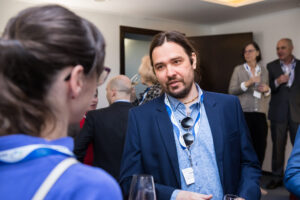 You have now received the Primus grant for your further research, which Charles University awards to promising young scientists. What kind of support does this project provide and what are your plans within it?
First of all, the project gives me the opportunity to build my own research team. My current colleagues are postdoctoral researcher Esraa Mahmoud and Andriy Trailin. Furthermore two Ph.D. students Muunda Mudenda and Nassim Rouayed have been recruited and have already joined our team.
Moreover, grant will allow us to systematically develop a new line of research focused on colorectal cancer metastasis timing. The goal is to better understand the biology of tumor spread and to identify molecular markers that could help improve prognosis and treatment of patients in the future.
Could you tell us what you like to do in your free time?
Besides work-related interests, I enjoy drawing in my sketchbook in my free time, reading a good book, preferably fantasy and science fiction. Additionally, I’m collecting vinyls with rock music, most preferable for 1960-1990. And playing tabletop role playing games.
How do you like Pilsen?
I really like it; it’s lovely place. The old city center is marvelous, in summer hot day Košutka or Bolevec can save life. Zoo is really nice place for Sunday walk.
Filip Ambrozkiewicz, Ph.D., is a senior researcher at the Faculty of Medicine in Pilsen, Charles University, where he conducts research in the fields of molecular biology and oncology. His work focuses on the study of genetic and epigenetic mechanisms that influence the onset and progression of cancer. He has long been particularly interested in the role of non-coding RNAs (e.g., miRNAs or lncRNAs) and their potential as biomarkers for use in the diagnosis and prognosis of tumors. He is a co-author of numerous scientific publications in international journals addressing topics such as hepatocellular carcinoma and other solid tumors. In his research, he combines experimental approaches with clinical data and contributes to the development of more precise methods in the field of personalized medicine.
Since 2017, Charles University has been announcing the Primus competition, designed for young promising scientists, especially those who are returning to Charles University after a long-term internship abroad or who have not yet worked at the University. The aim of the PRIMUS Research Programme is to support top researchers in establishing and developing new research groups and laboratories. One of the long-term objectives, which is being met, is also to increase the University’s success in obtaining international grants (e.g. European Research Council – ERC grants; see Excellence in Research). It is therefore expected that successful proposers will establish their own laboratories/research lines at Charles University and will be able to apply for ERC grants by the end of the Primus project.