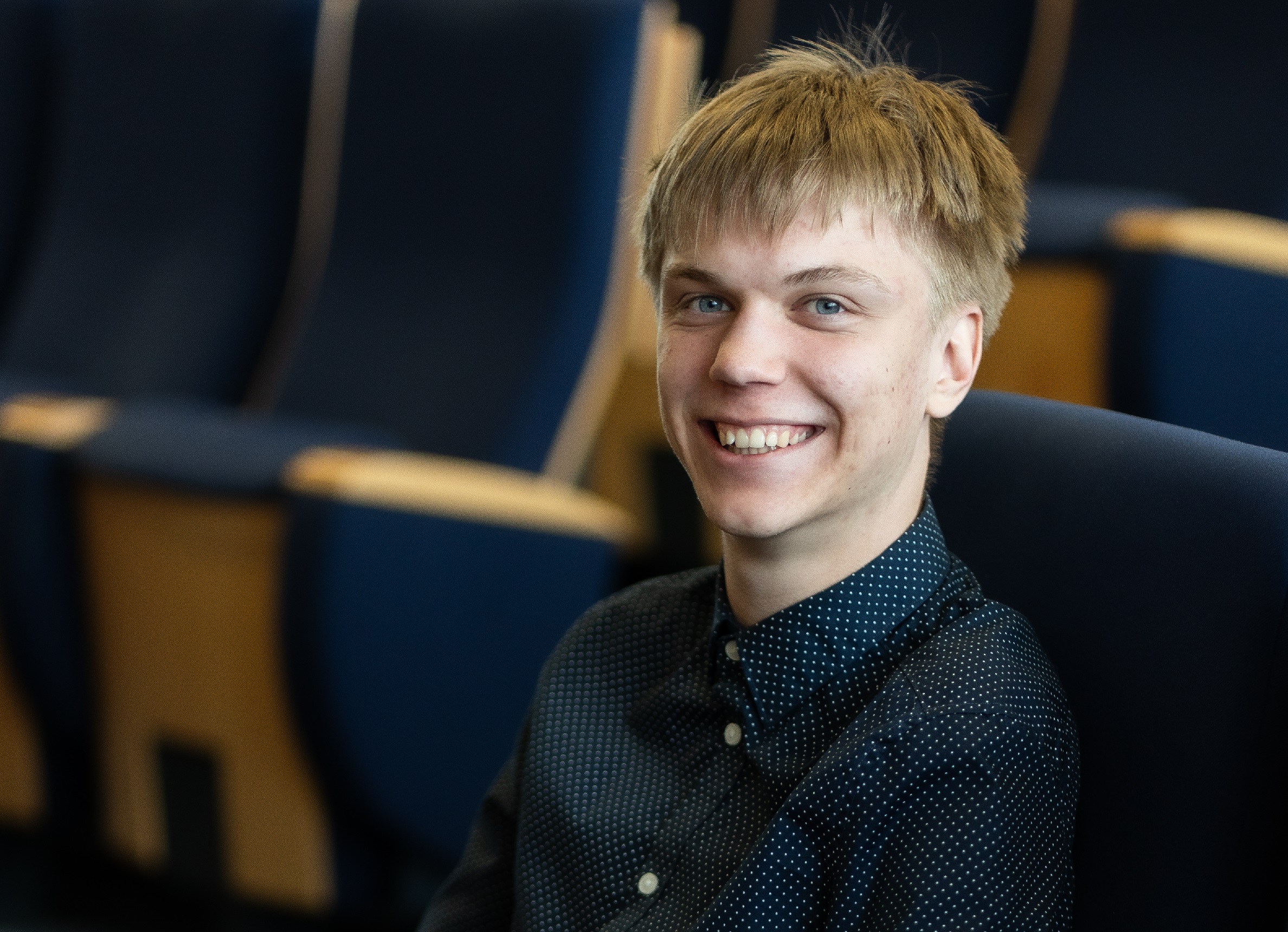
Matyáš Matta. A young inquisitive student of Masaryk Grammar School in Pilsen, this year’s graduate. One of the organizers of a very successful event “Consider Science!”, which aims to spark enthusiasm for science in young people. A member of the GoHigher community of gifted and enthusiastic talents, he gained his experience during internships at the European Youth Parliament in the Czech Republic and the NTC – New Technologies Research Centre at the University of West Bohemia (UWB) in Pilsen, as well as in his part-time job in one of Pilsen’s fast food restaurants. The latter work has equipped him perhaps the most for his life. He enjoys experimental physics, biochemistry, and medicine, and at the age of nineteen he has an account on the professional network LinkedIn, and his posts are ‘liked’ even by the former Chancellor of the UWB, Miroslav Holeček. It is to the UWB, namely to the Faculty of Applied Sciences, that his steps will probably lead after graduation, “because the courses in Prague are prestigious, but not very practical”.
Matyáš, together with Jan Herzig, you are the main organizers of the event ‘Consider science!’, right?
Yes, that’s right, I started organizing the event with Jan in 2023. We had never organized anything big before, so I certainly don’t think we were predisposed to it, but I would say we got the hang of it pretty quickly. People who had already done something similar were willing to help us. The event takes place at the Faculty of Applied Sciences at the UWB in Pilsen, where they also gave us some advice on the organization. The more time we put into it, the more thorough we were. We actually had to prepare everything ourselves, we had to prepare the website, negotiate contracts, find out how things work, even the legal stuff. But I wouldn’t say that we’re excellent organizers per se, we just had the time, and experience came later.
Are there many of your peers who organize such big events?
No, probably not, but then they have other things to do, they do their sports and pursue their interests. We didn’t have so many things to do and so many interests, so we just threw ourselves into organizing this event, but I think if our peers really wanted to, they could do it too, it just isn’t necessarily their thing. It’s stressful, not everyone has the will to bear the stress and, of course, if there’s something you get out of it, it’s rather a good feeling. It’s not for everyone, and we had the ideal conditions for it.
So, was it that you had the time, and you wanted to do something, or did you feel that there was a lack of such particular events, and that it was necessary to start organizing them?
With the AstroX project, we had a small lecture at the Faculty of Applied Sciences. It was a great success, it got pretty good publicity, and it was nice, because we could show others what we were doing. And we thought that was great. So, when I was wondering when we could organize something again that would be a little bit commendable, public, I just thought of something like “Consider Science!”, because there hadn’t been such a thing, and secondly, we had that autumn at our hands to do it. There was a gap in the market, so it was worth at least trying. It turned out that it could be quite successful, and that nobody was doing anything similar in the whole country, so it was unique in that respect. So, the idea came first, then we started piecing it together.
Would you say, then, that you feel that science or technology is not that popular among your peers?
I would like to say that they are, or that they are increasing in popularity, but generally that’s not the case. I don’t think technical, science, or overall science disciplines are very popular in general. The level of students, as much as we hear about it, isn’t the best either, so we thought it was a good idea to present it to the wider public. We live in a time when people often don’t believe in science, they think it’s useless. It’s called popularization, but in short, it’s about making people understand that science is important, and it’s an opportunity for them to develop. I would say that’s the main reason why we did it. Natural sciences, science in general, are not particularly popular, compared to the past. I think it’s important to convince people that common sense does have a place in this world, and that there are methods for us to better understand that
I guess there’s no science in Instagram trends=)
Well, we could argue that there is, but there isn’t, and never has been. And I don’t think it ever will be either, but we can do our bit here on the planet to improve the situation just a little, because we see what happens when people who don’t believe in science, and deny reason, get into high profile positions. I think it’s important to convince people that there is such a thing as truth, and that there are people who are dedicated to it.
You’re 19 years old. It’s not that I wasn’t thinking about the world at your age, but I didn’t realise so much then, whether the line of work I wanted to pursue was something a lot of people or not so many wanted to do, whether I was going to land a good job, I just enjoyed it. And you think about it a lot (and) in depth!
To some extent, thinking about it doesn’t change the outcome. I don’t think about it very much, and I don’t come up with much. I guess if you ended up where you wanted to, it was better for you than spending all your adolescence thinking about it. I believe it’s important to show people that science is an option for them to consider. But we don’t want to tell anyone that that’s their path. We know that for a lot of people it’s not going to be it, not everybody likes equations, not everybody is interested in science, but everybody should know about it, and that they can grow in it, and that when they’re choosing their college and their direction, science is one of the possibilities. It’s an option that’s quite lightly populated with students, quite promising, and in the future, I think few things have as much potential as engineering and natural sciences. I would say it’s good to inform people, and especially our peers, that the option is there, and get them to consider it. But how they decide is their business, after all.
rsation, that mathematics, physics, and chemistry are part of our everyday life, and that we encounter them on a daily basis, which probably few of us realise. A fair number of us are probably used to the idea that we just push a button and something works. We have apps on our phone for everything, a lot of things are automatic, and we don’t even try to look into them, to control them properly.
For a lot of people, it’s just enough to know the input, the output, and not what happens in between. That’s certainly more true now than ever before, because, for example, how a phone works, nobody…including me, if I had to explain it, I wouldn’t know how. Science today is highly specialised, and understanding something, especially when technology has advanced so much, you can’t really understand it anymore, and a lot of people just need to know what to push to get that output. It’s just like neural networks. We don’t know what’s going on between them anymore either, we just need to know the inputs and outputs, and that it works. When one understands how the things in between work, it’s a kind of joy, but it’s definitely a really rocky road, and it doesn’t fundamentally change that output…If someone uses Instagram, they probably don’t need to know how the networks work, what waves Wi-Fi runs on. But as a scientist, I believe it’s nice to understand it. And then maybe when the thing stops working, it’s good to know what needs to be fixed. In general, knowledge is useful, but in a world where everything operates by itself, you don’t need to know anything. That’s unfortunately true. That’s why it’s important to convince people that even if they don’t get any financial gain from it, or don’t get anything out of it, it’s still good to understand why the earth is round, and that they can verify it for themselves. It’s good to understand that with a scientific method, everyone can check for themselves that the things they believe are true. I think that’s important.
Nowadays, on the one hand, it’s extremely easy to find information about everything, which makes studying easier in some ways, but at the same time, it’s much harder to concentrate. Moreover, some people relativize a lot of things, and when you say “check the truth”, the truth for them is that the earth is not round.
I read in an article that it used to be believed by a doctor that people were stupid because they were uninformed. Nowadays, we know that it’s definitely not the case. People are superbly informed. But the important factor is what information reaches them. We are no longer able to take in all of the information the world has to offer. We must be able to filter, and that’s simply not possible when there’s such a vast amount of information. We have to try to understand it, and try to look for reality in the context, but it’s just hard. It’s harder than it’s ever been before, when there’s just so much information. When you believe in something, it’s easy to look up the facts that support it, and turn a blind eye to the facts that contradict it. You see where the world is going. It’s important to understand it, but sometimes I don’t know if it actually has a point.
Let me go back to Consider Science! I was wondering, if you hold an event like that professionally, brilliantly, and successfully, if you’ve actually maybe considered not considering science, and having a career in organizing?
I still see myself in science, and probably more so than I in organizing things. I would say that Honza Herzig, who was particularly engaged in the event last autumn, and it was mainly him working on it, because I had other things to worry about, he put a lot of effort into it, and he’s a very capable organizer. I’m capable in many ways myself, I can learn things, I’ve had to program websites, edit videos…I can learn practical things, but I don’t have the mental capacity to manage things. I can’t concentrate on one project for 3 months, and have irregular working hours, so I personally will take the science route, but it’s definitely nice to spice it up with some popularization activities. But I think Honza has really put a lot of energy into it, he can do absolutely amazing things, and time will tell if he’ll consider science, or if he’ll keep it as a side thing. We’ve discussed it recently, but we haven’t come to any definite conclusion.
I know quite a few people who attended popular technical secondary schools, but are now not involved in technology at all. I believe everyone should study what they’re interested in, and then maybe life will take them somewhere else, or they’ll simply find out for themselves whether it was a good choice, whether they enjoy it.
In today’s society, you don’t have to do what you studied for the rest of your life. That’s changed a lot in the last 20, 30 years. It’s kind of a western trend. Actually, what you learn at school, what we learn at university, the facts and the practical knowledge, what you do on a daily basis later on, also differs a lot. The science that one studies and the science that one actually does are very different things. So, I don’t think it’s such a problem to move on to popularization or some other activity altogether, because after all, the practical experience is still quite different from what you learn in school. Anyway, you have to start gaining this practical experience from 0, so whether it’s in managing things or in science…I think that knowledge in technical fields also leads a lot to having a different approach to things, to being able to think analytically about things. That can definitely be used in any field, in any job. I think it can be of great importance in one’s life, but then the question is whether it makes sense to do a PhD in physics if I want to do science promotion. I think we’re all going to go into engineering or science. How many of us will stick with them is a question then, because it’s a long journey, and everyone needs something different. For those of us who organize these events, the question is what we will enjoy more. Personally, I’m quite comfortable with research, I’m well suited to it, but I also need contact with people.
 If, let’s say, a naysayer argued in a discussion on social media that young people today don’t want to work, don’t want to study anything demanding, and therefore don’t choose careers in technical fields, and just want to be influencers. What would you say to them?
That this is a generalization, and such generalizations can never capture the whole reality. Of course, I can’t argue that I don’t know any such people. I guess we all do, but to say that all young people today are like that, and that this is the whole generation… You always have to accept that the truth is complex. It must be broken down into individual elements. We can talk about some trends where the will to study these fields is actually not what it used to be, people really might be a bit more comfortable than they used to be. We do have these outcomes, but I don’t think you can generalize it to an entire generation, and there are certainly elements of our generation that are better than in the previous generations. I think we all want to work, but we also want decent conditions, and some work-life balance. We want to have a sort of balance in our lives, and do what we enjoy, not just to make a living. Our priorities are certainly different, but I think it’s not true to say that young people don’t want to work. That’s my conclusion. I’m sure there are some, but there have probably been in every generation, so I don’t see that as a true statement.
I’m a millennial. I don’t have much interaction with your generation, Gen Z. I read some discussions, and that’s how I form an opinion, but it’s quite different from how I experienced the GoHigher community, or you, Jan Herzig, or Anna Krebsová in personal conversations. You seem very mature, like young adults who have their priorities straight.
We’re also a specific group that doesn’t represent our generation as a whole, and I think there have probably been some in every generation who just think a little more maturely than others. Even in our generation, you can find those who want to work, want to make the world a little bit better. A lot of people don’t get that. I think it’s important to show that we’re capable of doing something too. In time, everyone will find out, we’ll see. You see a lot of extreme tendencies in the media, don’t you? I’ve recently seen a documentary on Czech Television about our generation called “Snowflakes on the Verge of Melting”. Of course, there are some trends, and I certainly can’t deny it, I’m sure it’s true, but it also implies something. It’s not simply that we’re weaker, lazier, and more comfortable than everyone before us, it’s just that we come from the environment we grew up in. I’m sure the environment we will work and live in later will affect us again. And it certainly won’t be as comfortable as what we’ve experienced so far, so I think in the end we’ll be just as hardworking as the generations before us. Hopefully, a little more self-aware, and being able to think about things a little bit, hopefully we won’t go back to moments in history when people didn’t think. Let’s hope so. Thinking critically about the world, I think, is more inherent in today’s generation than it used to be. But when you’re too aware of things, you’re not entirely happy about what’s going on. I believe that critical thinking, being critical of the world, will help us to run the world a little more straightforwardly, and not as radically as those before us. I hope so.